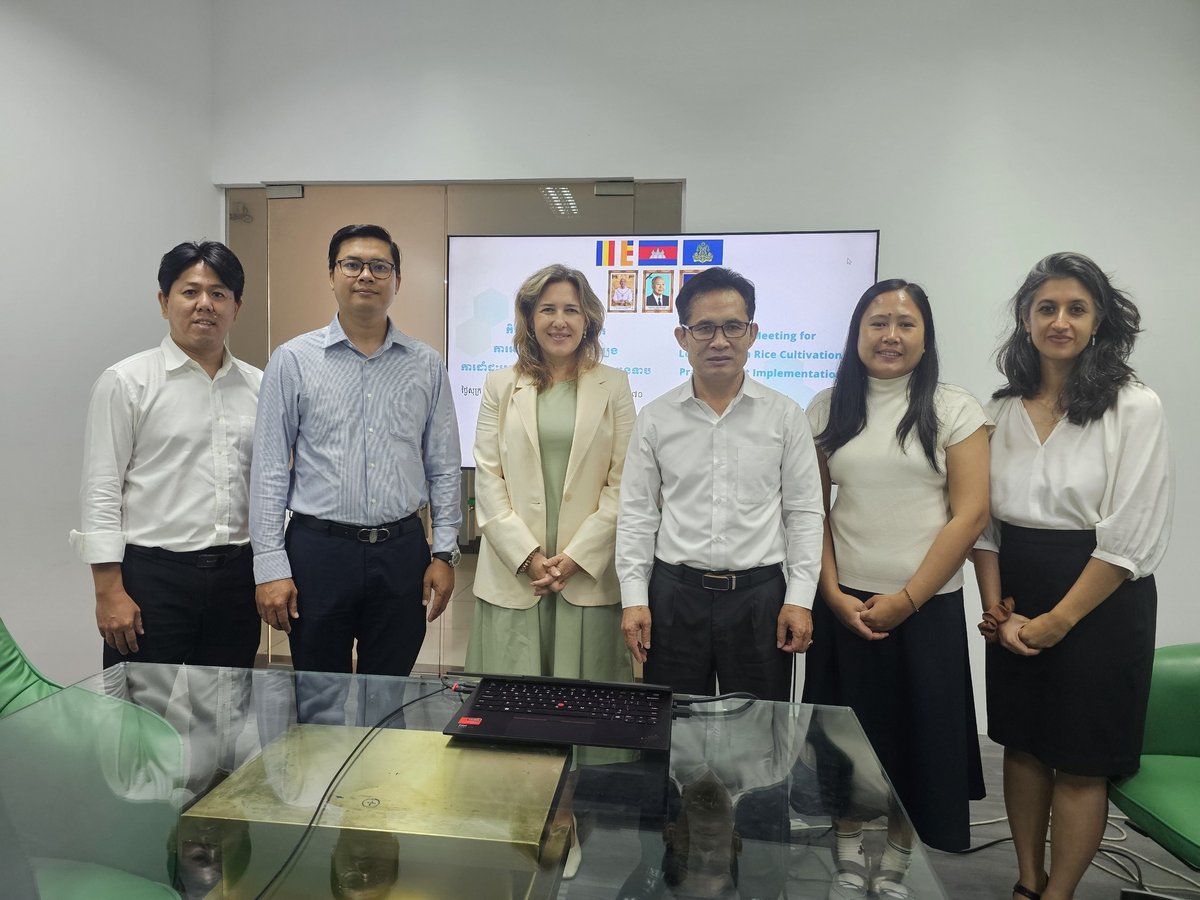
Phnom Penh/Seoul, 07 August 2026 – The Global Green Growth Institute (GGGI) and the Korea Rural Community Corporation (KRC) convened their first technical meeting to coordinate the implementation of a low-emission rice cultivation practice in Cambodia.
The meeting marked an important milestone under the ASEAN-Korea Cooperation for Methane Mitigation (AKCMM) project, a regional initiative funded by the ASEAN-Korea Cooperation Fund (AKCF) and implemented by the Global Green Growth Institute together with the Ministry of Environment (MOE) and the Ministry of Agriculture, Forestry and Fisheries (MAFF).
Cambodia will be the first participating country to implement the project’s methane-reduction activities through the introduction of an Alternate Wetting and Drying (AWD).
Dr. Yorn Try, Deputy Director General, General Directorate of Agronomy, Ministry of Agriculture, Forestry and Fisheries, said, “Rice cultivation is central to Cambodia’s agricultural sector and the livelihoods of millions of Cambodian farmers. The AWD pilot will allow us to assess a practical approach that can improve the effectiveness of water management, reduce lodging rate and methane emissions, and contribute to more climate-resilient rice production.”
Mr. Nathalie Andre, GGGI Cambodia Country Representative, said, “This pilot represents an important step in translating regional cooperation into practical climate action. By introducing Alternate Wetting and Drying in Cambodia, we aim to demonstrate how methane emissions from rice cultivation can be reduced while maintaining productivity and supporting farmers.”
Mr. Dongjin Kim, Deputy Director, Korea Rural Community Corporation representative, said, “KRC is proud to bring its proven technical expertise in agricultural water management to the AWD pilot in Cambodia. Working in close partnership with GGGI, the General Directorate of Agronomy (GDA), local authorities, and participating farmers, we will help build an effective and measurably verifiable pilot model. KRC remains firmly committed to strengthening Korea–ASEAN knowledge exchange and to advancing sustainable, low-emission agriculture across the region.”
The AKCMM initiative serves as a catalyst for unlocking green finance and boosting Cambodia’s agricultural competitiveness. By promoting climate-smart practices, the project will help reduce emissions while delivering co-benefits in public health, food security, and sustainable livelihoods. The AKCMM project is being implemented from 2024 to 2027 in nine ASEAN member states, including Cambodia, and supports the adoption of scalable, low-emission rice farming practices across the region.