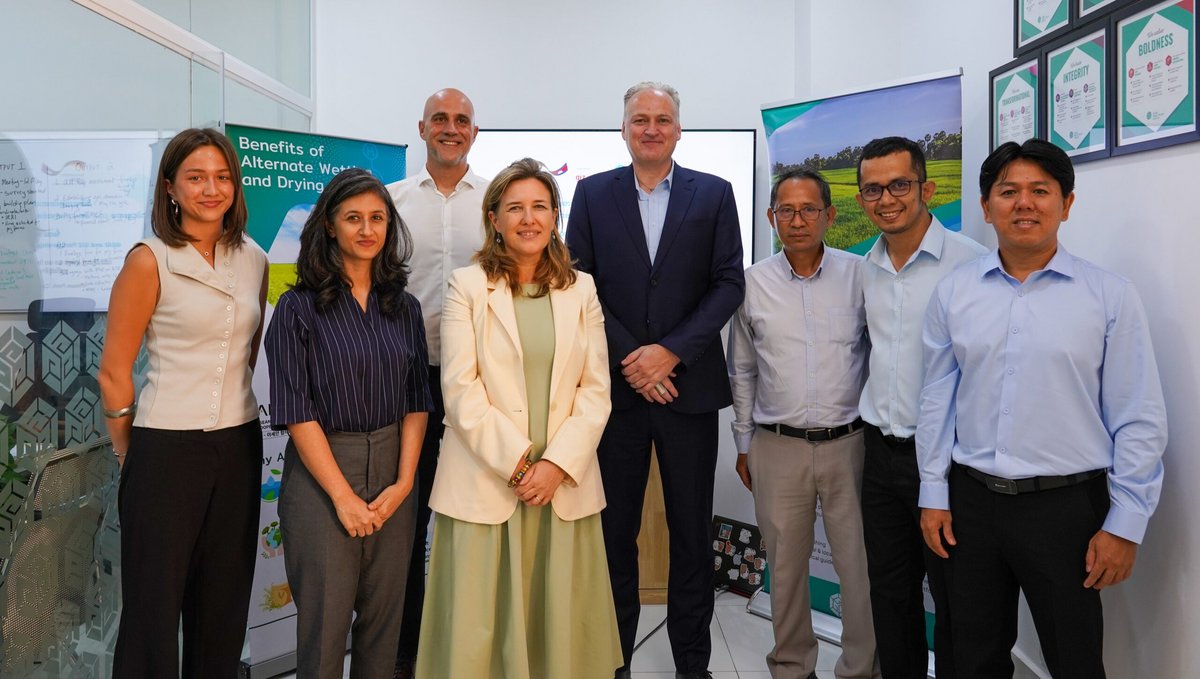
Phnom Penh, Cambodia, 11 August 2026 – The Global Green Growth Institute (GGGI) and the Deutsche Gesellschaft für Internationale Zusammenarbeit (GIZ) GmbH signed a Memorandum of Understanding (MoU) to strengthen collaboration on low-emission rice production, climate-resilient agriculture, and carbon market opportunities in Kampong Thom province, Cambodia.
The collaboration builds on GGGI’s ASEAN-Korea Cooperation for Methane Mitigation (AKCMM) project and GIZ’s Better Rice Initiative Cambodia (BRIC). Under BRIC, GIZ supports the implementation of Alternate Wetting and Drying (AWD) in Baray district, while GGGI implements low-emission rice activities in Santuk, Kampong Svay, and Stung Sen under AKCMM. The MoU will strengthen coordination between these efforts and support the scale-up of low-emission rice solutions.
Ms. Anantaa Pandey, Senior Program Officer, GGGI, said, “By strengthening coordination between GGGI and GIZ, we aim to translate AWD into practical, on-the-ground opportunities for farmers — while advancing Cambodia’s climate commitments under Article 6 and supporting the long-term sustainability of the rice sector.”
Mr. Lucas Zahl, Project Manager of GIZ’s BRIC, emphasized that this MOU marks a key milestone in scaling climate-resilient agriculture across Cambodia. By combining The Better Rice Initiative Cambodia (BRIC), implemented by GIZ, and our field experience in farmer training and sustainable rice value chains with GGGI’s expertise in methane measurement, carbon finance, and Article 6 mechanisms, we are building a strong platform for innovation. Together, we will advance low-emission practices, rice straw management, and national MRV systems, helping smallholder farmers boost productivity and climate resilience while unlocking new carbon market opportunities for Cambodia.
Under the MOU, GGGI and GIZ will collaborate on the scale-up of AWD and other low-emission rice practices, strengthening methane accounting and MRV systems, developing carbon market opportunities, promoting low-emission rice markets, exploring sustainable rice straw management solutions, developing training and extension services, and supporting research on data monitoring and Article 6 applications.